



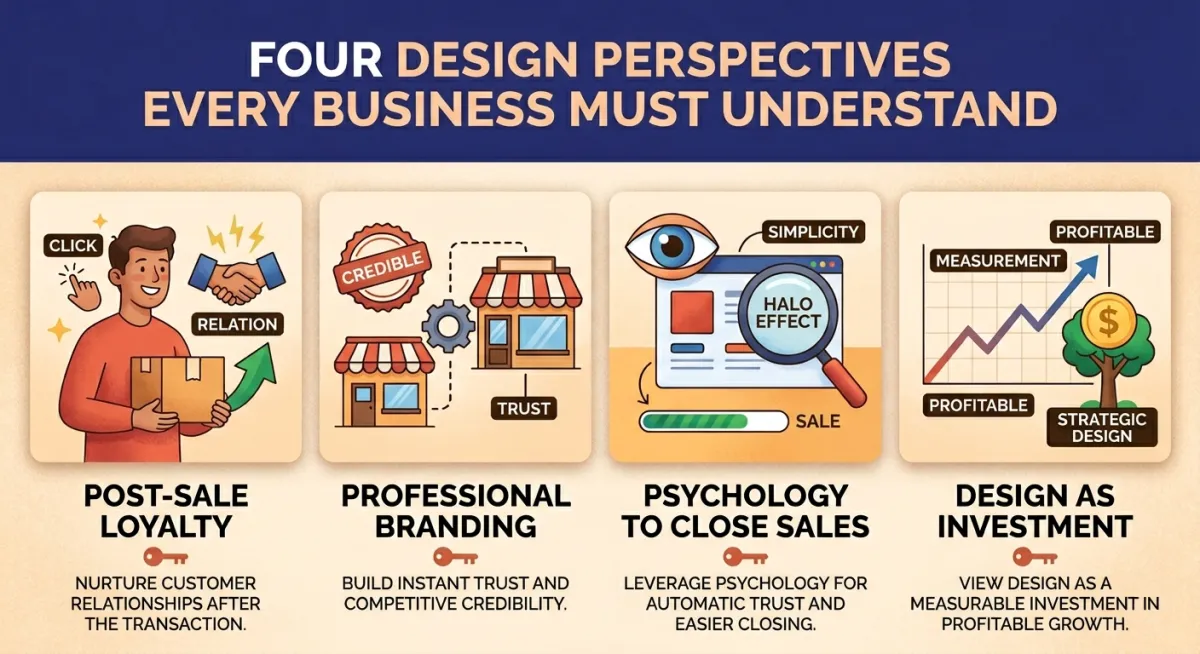
Four Perspectives on Design Every Business Should Understand (Even If They Seem Opposing)
Looking at those four headlines, they appear to be about different things:
post-sale loyalty
branding for small businesses
psychology to close sales
design as an investment
But in reality, they arefour sides of the same problem: how design stops being an "extra" and becomes the real engine of a profitable business.
Here's why each one brings something unique – and why you shouldn't stick with only the first.
1. From Click to Loyalty: Design That WorksAfterthe Sale
Most businesses care about design up until the "buy" button. After that… silence.
But loyalty isn't born at the click – it's born from what happensafter:
Is your confirmation email clear or does it look like spam?
Is your customer area easy to use or a maze?
Does your packaging communicate something or just wrap the product?
Post-sale design turns a transaction into a relationship. Without it, the click is just an event, not a beginning.
2. Why Professional Branding Is Essential for Small Businesses (And No, It's Not Just a Nice Logo)
A small business without professional branding isn't "lean" – it'sinvisible.
When you compete against big brands, your branding isn't a luxury: it's your only tool to be taken seriously. A small entrepreneur with poor visual identity gives the feeling of "they might close any day". One with consistent branding, even with two employees, looks trustworthy.
Professional branding isn't expensive: it's the difference between looking like a hobby or a real business.
3. The Psychology of Trust: How Design Closes Sales Without Saying a Word
Here many get it wrong: they think selling is about persuading with arguments.
But designsells before you read the first line.
Two key psychological phenomena:
Halo Effect: if something looks good, we assume it works well.
Cognitive Fluency: if something is easy to process, it feels more true.
Clean design with clear hierarchies and proper spacing activates both. The user doesn't "decide" to trust – their brain does it automatically. And that's where the sale closes, long before price or offer.
4. Is Strategic Design an Investment or an Expense? (The Question That Separates Growing Businesses From Survivors)
If you see design as an expense, you'll look for the cheapest designer and cut back when times get tough.
If you see it as an investment, you'll measure its return:
Did the average ticket go up?
Did cart abandonment drop?
Do customers take less time to understand your offer?
Strategic design isn't justified with "I like it" – it's justified with data. And when you measure it, you discover thatnot designing is more expensive than designing well.
Conclusion (And a Practical Tip)
Don't choose just one of these four approaches.
A solid business needs:
✔ post-sale design to build loyalty
✔ professional branding to be credible
✔ visual psychology to close sales
✔ an investment mindset to survive and thrive
And if today you can only improve one, start with the one that hurts the most. Because design isn't what you see – it's what your customer feels without knowing it.


